
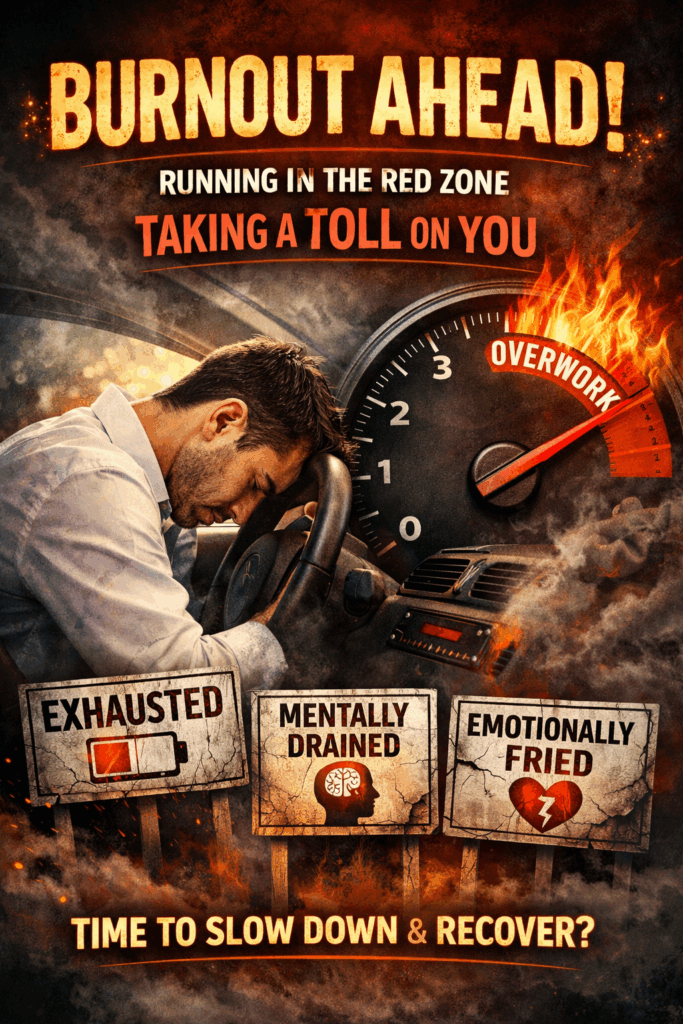
Understanding Burnout and Overwork in High-Demand Lives
In our collective society, productivity and progression are often treated as essential ingredients for success. In conversations about burnout and overwork, it becomes increasingly clear that the pressure to constantly advance—whether in career, relationships, or personal goals—often carries unseen consequences. Sometimes we push so hard toward productivity that the effort itself begins to take a toll. These effects may show up physically, emotionally, mentally, or socially, and when they go unacknowledged, burnout becomes not only possible, but likely.
Productivity, Progression, and Burnout From Overwork
A simple way to understand burnout is through the analogy of a car. All cars have a “red zone” on the RPM gauge. This red zone signals inefficiency and danger—an operating range the engine is not designed to sustain for long periods. The exact threshold may vary depending on the vehicle, but the message remains the same: do not stay here, or engine failure may occur.
Running in the Red Zone: Burnout and Overwork in Action
When a car is pushed in the red zone for too long, the engine eventually fails due to accumulated internal strain. People experience a similar pattern when functioning in prolonged states of burnout and overwork. What may initially feel manageable slowly becomes unsustainable, often without immediate or obvious warning signs.
This analogy mirrors how burnout and overwork develop in individuals who remain in high-demand states without adequate recovery.
What Is Burnout? A Working Definition
How does someone know they are operating in this range of overwork and inefficiency? What happens when burnout is reached? Is recovery possible? These are valid and common questions—ones I have been asked repeatedly throughout my clinical work.
According to the APA Dictionary of Psychology (2020), burnout is defined as:
“Physical, emotional, or mental exhaustion accompanied by decreased motivation, lowered performance, and negative attitudes toward oneself and others… resulting from prolonged stress, extreme exertion, or an overburdening workload.”
Burnout as Physical, Emotional, and Mental Exhaustion
Burnout is most often observed in service-oriented professions such as social work, teaching, and healthcare, where chronic stress is common. It can be particularly acute for therapists and counselors engaged in trauma work, as cumulative exposure to others’ suffering adds an additional emotional burden. Athletes may also experience burnout when performance demands persist without sufficient rest or reward.
From a clinical perspective, burnout and overwork are cumulative processes rather than sudden events. In my experience, burnout can occur in anyone facing sustained demands—whether or not those demands are tied to formal employment. Often, it is the degree of involvement in a task, role, or responsibility that eventually exceeds one’s capacity to maintain balance.
Signs and Symptoms of Burnout and Overwork
One of the most difficult aspects of burnout is recognizing it in oneself. Many individuals remain in denial long after symptoms emerge. While someone may still appear “functional,” that does not mean they are functioning with the same enthusiasm, connection, or sense of purpose they once had.
Emotional and Mental Warning Signs of Burnout
As the definition suggests, burnout and overwork often involve emotional exhaustion, mental fatigue, and increasingly negative attitudes toward oneself and others. I would also add that frustration or resentment toward the work or activity itself frequently emerges.
These changes often begin subtly. A single day of disinterest turns into several. Motivation declines. Irritability increases. Tasks that once felt manageable now feel heavy or draining. Over time, attending work or engaging in responsibilities becomes something to endure rather than participate in.
Burnout and Overwork Beyond the Workplace
Burnout is not limited to professional settings. Emotional demands outside of work can be just as taxing.
Emotional Burnout in Relationships and Caretaking Roles
When a relationship becomes emotionally lopsided, one partner may feel a constant pressure to be present, responsive, or supportive. Over time, this imbalance can contribute to burnout and overwork in the emotional sense—leading to frustration, resentment, emotional numbness, or questioning one’s place in the relationship.
Emotional imbalance and unmet boundaries are often overlooked contributors to burnout and overwork, particularly when care, loyalty, or obligation are involved.
Burnout, Boundaries, and the Cost of Being Too Available
In many cases, establishing boundaries earlier could have protected against emotional exhaustion. Boundaries help regulate accessibility and preserve emotional resources. Paying attention to how a relationship unfolds under strain can also reveal whether it is sustainable or appropriate in the long term.
Why People Stay in Burnout Longer Than They Should
Despite recognizing burnout, change is not always easy. The longer someone remains in a high-demand state, the more difficult it can feel to step away from it.
Denial, Obligation, and Fear of Change
Some individuals remain in burnout because of a goal they are pursuing, financial incentives, or fear of perceived consequences. These reasons are understandable. Still, I often return to a single question: At what cost?
The Hidden Cost of Burnout and Overwork
Even when productivity is rewarded or self-sacrifice is praised, burnout and overwork often come with subtle losses—changes in mood, character, connection, and sense of groundedness. These shifts tend to happen quietly and gradually, making them easy to dismiss until they become difficult to reverse.
Acknowledging Burnout as an Act of Self-Care
Acknowledging burnout and overwork is not a sign of weakness. It is an act of self-respect and long-term care. Recognizing when you have exceeded your sustainable limits allows for intentional course correction before exhaustion becomes chronic.
Being mindful of the costs of your actions creates space to consider alternatives—ones that support health, balance, and the ability to engage with life on more grounded and sustainable terms.
Be mindful of the costs of your actions so that you may at least consider alternatives. Lets explore what those alternatives may be, https://revivethrivecounseling.com/contact/
Here is a curious perspective on burnout through analytical psychology, https://youtu.be/HrccS2JoxPo?si=ut9GyMVzrL_d-zJW