
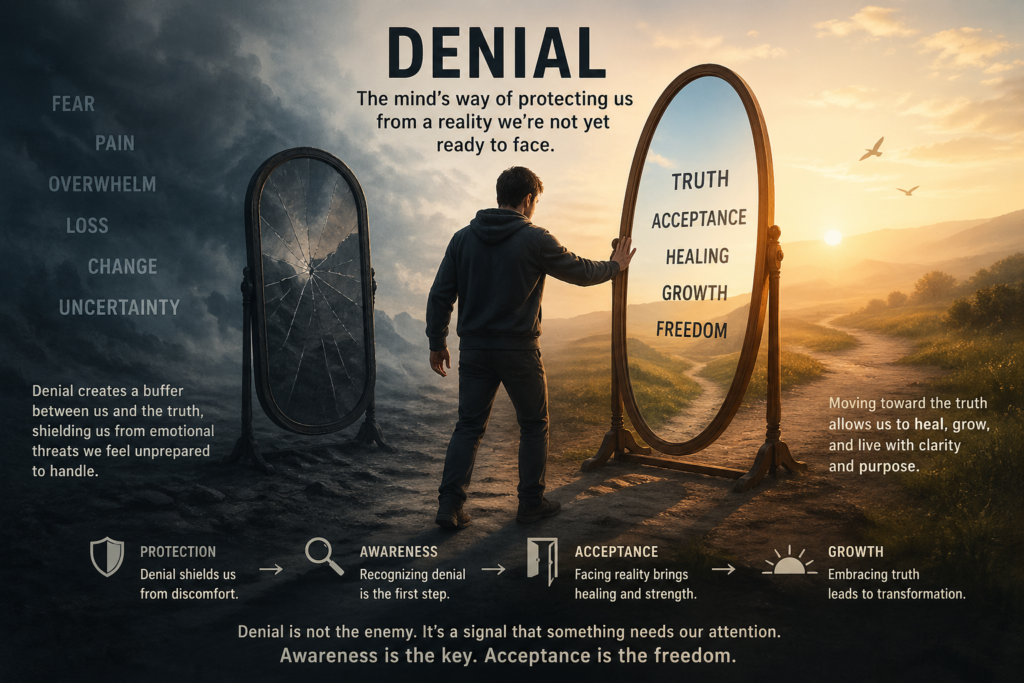
Understanding Denial in Everyday Life
Denial as a defense mechanism is something many individuals experience at one moment or another, even if they do not recognize it at the time. You may not have noticed it or defined it as denial, however it is very possible you were in denial. Denial is very commonly known to be the first stage of grief according to the Kübler-Ross Model. Although it is commonly associated with grief, denial can occur in a variety of forms, in different contexts, and with varying degrees of consequences.
It is sort of an altered state of being where our mind has difficulty differentiating reality from experience. It may sound odd to explain, however take the example of denial related to grief. Our mind is attempting to distinguish from experience (“I am used to seeing or knowing this person alive”) to reality (the person has passed and is no longer an “experience”).
Have you experienced some form of denial? If yes, how so?
What Is Denial as a Defense Mechanism?
Since I suggested denial can be experienced in other forms and contexts, it is helpful to work off a common definition as we continue exploring the topic.
According to the APA Dictionary of Psychology, denial is:
“a defense mechanism in which unpleasant thoughts, feelings, wishes, or events are ignored or excluded from conscious awareness.”
It may take forms such as refusal to acknowledge a terminal illness, financial problem, addiction, or a partner’s infidelity. Denial is an unconscious process that functions to resolve emotional conflict or reduce anxiety.
Denial as a defense mechanism allows the mind to create distance from experiences that feel overwhelming or threatening.
Why Denial as a Defense Mechanism Exists
At this point, you may be asking:
- What is denial actually defending me from?
- How is it a defense mechanism if it creates disturbance in my reality?
These are extremely valid questions.
Defense mechanisms are meant to assist the mind in avoiding discomforting, threatening, or deeply challenging emotional and mental experiences. These experiences may be actual or perceived. Regardless, the mind processes them in a generalized way and acts accordingly.
With denial, we actively and sometimes consciously reject the reality of circumstances.
For example, someone might say:
“No, this isn’t true. I know this to be true,”
even when the latter is not grounded in reality.
In rejecting reality, we create a buffer between the truth and our ability to accept it.
Denial as Emotional Protection
Why does this buffer exist?
Because there may be a part—or all—of us that is not prepared to emotionally or mentally accept the truth. Accepting it may feel like a threat to our stability.
In an exaggerated sense, although not too far from the truth for some, the perceived threat can feel like:
- “death”
- “crisis”
- “suffocation”
While these may not be literal, the experience can feel real enough that the mind resists moving beyond it.
Now consider:
What are the things you consciously try to remove from your awareness?
What areas of your life might denial exist in? I wonder if its in a fear about failure as one example? https://revivethrivecounseling.com/failure-as-feedback-does-failure-really-exist/
The Cost of Staying in Denial
Now think about what might happen in a worst-case scenario if you accepted certain truths.
Some may say it would be the “end” of them. However, when we examine it rationally, actual harm is often unlikely. Instead, we tend to catastrophize to justify maintaining denial.
Why?
Because if we don’t, we may feel compelled to act.
And if we don’t feel prepared, capable, or strong enough, then facing reality can feel overwhelming.
So denial remains.
What once served as protection… begins to create limitation.
How Denial as a Defense Mechanism Affects Your Life
In more severe forms, denial can present as delusions—false beliefs that are often associated with psychosis. While these are more complex and involve additional factors, there is still a core element of rejecting reality.
Regardless of severity, the goal remains similar:
To support a return to or acceptance of reality as commonly understood and agreed upon.
This does not mean everyone thinks the same way, but rather that there is a general grounding in what is considered rational and appropriate.
When denial as a defense mechanism remains for too long, it can begin to distort reality and limit personal growth.
Moving from Denial to Acceptance
So how do we begin shifting out of denial?
We start by:
- Exploring the content of the denial
- Understanding resistance to acceptance
- Identifying underlying factors influencing perception
Doing this allows us to understand how denial functions and why it exists, beyond simply rejecting reality.
Working Through Denial at Your Own Pace
When we begin to work on the underlying factors, we create an opportunity to:
- Reframe thoughts
- Redirect behaviors
- Alleviate emotional distress
- Gradually move toward acceptance
For some, this may feel like a daunting task.
However, if done at a pace that feels manageable, while continuing to move forward, the likelihood of progress increases significantly.
There are no guarantees in psychology. However, taking intentional action and applying what you learn greatly increases your chances of overcoming denial and moving toward a more grounded, accepting, and aligned way of living. https://www.ebsco.com/research-starters/psychology/denial-cognitive-mechanism
Closing Reflection
Denial is not simply avoidance.
It is protection.
But at some point, what protects us must also be examined…
so it no longer limits us.
Thank you for exploring Denial. I look forward to knowing some of your thoughts.